
Fertilizer Action Plan – Position Paper
Fertilizer Action Plan: Towards a Competitive and Resilient EU Fertilizer Sector
1. Why we need fertilizers
Mineral fertilizers enable 50% of global food production[1]. For healthy plant growth, plants need soil that contains the right nutrients in the right quantities. However, every time a crop is harvested, it takes those nutrients with it, leaving the soil a little more depleted. This is why replenishing the nutrients after each harvest is so important. Without fertilization the soil gradually loses its ability to support healthy crops, threatening both farm productivity and our wider food supply.
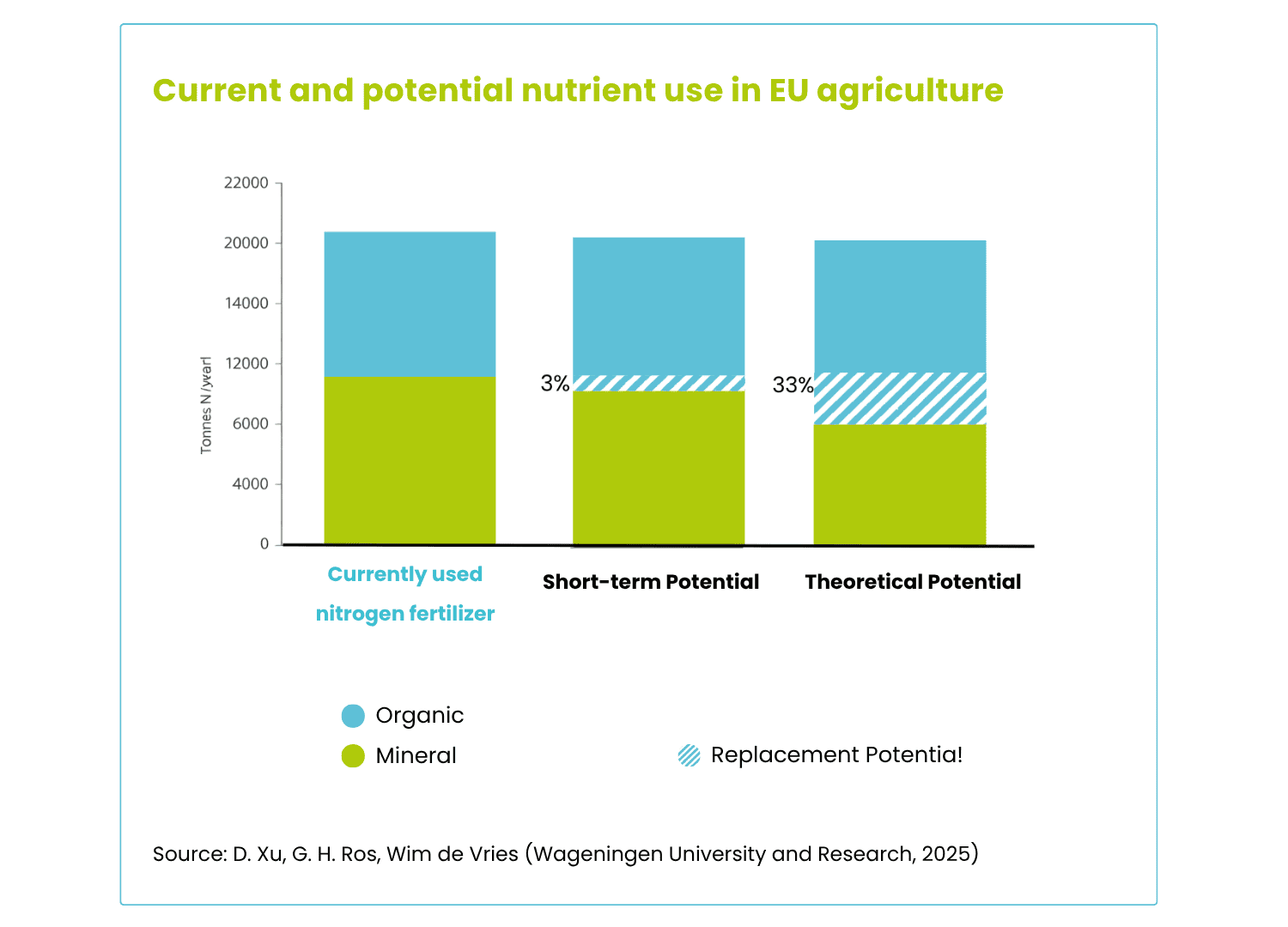
Recovered and organic nutrients are not a replacement for mineral inputs; these fertilizing products are complementary to one another. Under current technologies, organic fertilizers can replace up to 3% of currently applied N fertilizers, while technological improvements could, in theory, increase this to up to 33%[2].
Mineral fertilizers are essential for Europe’s food security.
2. Why Action Is Urgent
Recent geopolitical crises, from the COVID-19 pandemic to the wars in Ukraine and Iran and the resulting energy shocks, have challenged assumptions of stable and predictable global conditions, revealing the extent of Europe’s exposure to external dependencies. This has reinforced a clear reality: food security cannot be taken for granted.

Geopolitical Context
- Excessive dependence on external suppliers in critical sectors poses a significant systemic risk.
- Despite volatile global markets, the reliability of domestic fertilizers production ensures that essential needs of EU farmers are covered.
- Import diversification ≠ strategic autonomy. Sustainable resilience is ensured by maintaining and developing competitive domestic production.
The European fertilizer sector is critical to food security, agricultural productivity, and strategic value chains, including food processing, chemical building blocks, transport, and defence [3].

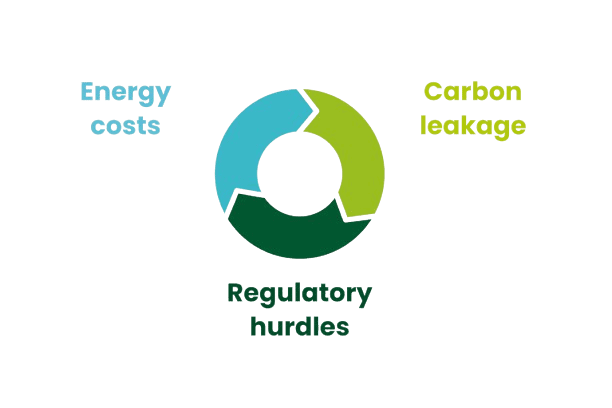
Despite its strategic importance, the European fertilizers industry is facing mounting structural pressures, including persistently high energy costs, carbon leakage risks, and regulatory burdens. These challenges are already undermining competitiveness and have led to the closure of several production sites.
Structural Challenges

Persistently high and volatile energy costs (natural gas and electricity) continues to put European producers at a structural disadvantage in global markets. The recent Gulf crisis is additional proof of how exposed fertilizers are.

Carbon leakage is happening. Rising carbon costs under the EU ETS, combined with CBAM implementation challenges and uneven global carbon pricing, further increase pressure on EU producers. This, in turn, leads to shutdowns, temporary curtailments of European capacities[4], and a growing reliance on imports.

Lack of conditions for investments, regulatory hurdles and sluggish demand for low-carbon and circular fertilizers.
By addressing these three structural challenges, Europe will secure the strategic autonomy it needs to navigate today’s turbulent geopolitical environment.
Without targeted action, Europe risks:
- Structural deindustrialisation, driving production and jobs out of the region rather than transforming them.
- Loss of investment in low-carbon and circular fertilizer projects.
- Increased dependency on imports with higher environmental footprint, leading to higher prices and structural dependencies.
- Reduced farmer competitiveness and resilience. Cheaper imports provide short-term benefits but weaken long-term strategic resilience and increase vulnerability to external price.
The Fertilizer Action Plan should therefore integrate industrial, agricultural, and climate policy into one coherent framework.
8 actions to secure a competitive and resilient EU fertilizer sector
1. Recognise European fertilizer industry as a strategic pillar of the EU’s strategic autonomy
Recent shocks, including the energy crisis and growing geopolitical instability, have shown that fertilizer supply can quickly become a strategic vulnerability. Excessive dependence on external suppliers therefore poses a serious risk to Europe’s food security.
a. Comprehensively assess the impact of current and new legislative proposals on the fertilizer industry.
b. Enable targeted, sector-specific policies that take into account the unique role of fertilizers, an industry at the crossroad of agriculture, chemicals and energy-intensive.
c. Reduce external dependencies for critical inputs to safeguard long-term stability.
d. Avoid disruptions in domestic fertilizer production to prevent knock-on effects on farm output and food security.
- Identify production sites of ammonia and fertilizers as critical.
e. Address the risks of capacity closures in the sector, with fertilizer assets as vital part of key chemical complexes.
f. Consider how upcoming regulatory requirements across the value chain may, in aggregate, create disproportionate pressures that risk negatively affecting the affordability of mineral fertilizers.
g. Create demand for lower-carbon, renewable-based, and recovered mineral fertilizers to support sustainable European production.
2. Strengthen EU’s industry competitiveness
European producers face increasing unfair competition from third countries. Competitive disadvantages led to shutdowns and reduction of industry’s output, making European farmers increasingly dependent on imported products.
a. Ensure a level playing field on energy and carbon costs (see points 3 and 4).
b. Ensure economic competitiveness of the entire agri-food chain.
Relief for farmers in high price scenarios should not be addressed by worsening competitive position of EU producers.
- Instead, targeted support for farmers should prioritise EU-made products.
c. Ensure technological neutrality to secure necessary investment and reduce the costs of the transition.
d. Develop new legislation focused on incentives across the entire value chain and de-risking investments instead of penalties.
e. Reduce red tape – eliminate excessive reporting and ensure regulatory consistency.
- For example, the implementation of the Packaging and Packaging Waste Regulation (PPWR) should be assessed whether the specific characteristics of fertilizer production and distribution justify a targeted reuse exemption for fertilizer producers and related packaging.
3. Bring energy costs down
The fertilizer industry is the largest industrial user of natural gas, which is used as both a feedstock and raw material. Around 80% of the operating costs are attributed to gas. Meanwhile, EU faces gas costs 4–5x higher than the USA and 2–3x higher electricity costs compared to other regions.[5] High energy costs threaten EU industrial competitiveness: in the short term, this leads to temporary shutdowns and even permanent closures. In the mid- to long-term, this undermines incentives to invest in long-term, low-carbon production capacity in Europe.
a. Restore gas competitiveness.
In the short term, the EU and Member States can reduce the gas costs by providing temporary state aid, diversifying supply, increasing domestic gas supply.
• Put in place a Stop-the-Clock Mechanism to provide time for workable solutions for targeted adjustments to the EU Methane Regulation to avoid severe disruptions to Europe’s gas supply.
• In the mid- to long-term, policy responses must acknowledge the above-mentioned realities and avoid creating additional, disproportionate burdens under EU or national control.
• Ensure that taxes, grid fees, and other cost elements set or influenced at EU and national level remain proportionate and predictable throughout the transition.
4. Address carbon leakage
The EU fertilizer industry has been under ETS for over a decade. In recent years, EU industry paid over 500 million EUR per year on allowances. Importers do not face any or much lower carbon emission costs putting EU producers at a significant competitive disadvantage.
a. Strengthen the mechanisms to prevent carbon leakage and ensure coherence between the EU ETS and CBAM.
b. Maintain the current level of free allowances in the ETS at least until 2030.
c. Keep product benchmarks and fuel and heat benchmarks for the period 2026–2030 at the same level of the previous ETS period for the fertilizer sector.
d. Ensure that any carbon price or environmental policy does not negatively impact the competitiveness of EU industries.
e. Develop a real export solution for CBAM sectors.
f. Guarantee the stable and predictable implementation of CBAM for fertilizers.
- Avoid and remove harmful regulations that destabilise the market and undermine long-term predictability, such as the proposed Article 27a in the draft amendment to the CBAM Regulation.
g. Ensure that all ETS revenues are redirected to financing the transition of the fertilizer industry and, when necessary, supports the affordability of EU produced fertilizers for European farmers.
h. Offset any potential impact of CBAM on fertilizers’ costs in Europe by directing the mechanism’s revenues to farmers.
5. Ensure a level playing field vis-à-vis imports
A robust framework is needed to ensure that EU producers compete under fair conditions with imports. This requires effective use of trade defence instruments and policy coherence across trade, energy, and climate measures to prevent unfair practices and regulatory imbalances.
a. Consider all policy instruments combating unfair competition to ensure a real level playing field for EU fertilizer industry both on the domestic and international markets.
b. Use all trade defence instruments to address dumping and to prevent circumvention practices.
c. Maintain trade defence measures, even in case of temporary geopolitical shock and trade disruptions.
- The antidumping/antisubsidy proceedings are lengthy, purely technical processes, based on criteria described in detail in EU regulations – they provide long lasting defence against third countries’ harmful and unfair practices.
d. Align trade, energy, and climate policy across Commission services.
6. Boost demand for low-carbon and circular fertilizers
Low-carbon and renewable fertilizers come with a significantly higher price tag, presenting new market barriers especially among end-users in agriculture. Therefore, public support and regulatory frameworks that encourage demand are essential to accelerate the transition.
a. Create a regulatory framework that boosts the uptake and gradual demand increase for low-carbon fertilizers.
- Create downstream demand side incentives for low-carbon products, such as targeted quotas, mandates, tax incentives, and support schemes, and that facilitate market access for sustainable solutions
- Develop an EU-wide certification and labelling system for low-carbon agricultural inputs, complemented by an EU-harmonized consumer label that clearly identifies low-carbon products will build trust and stimulate uptake
b. Simplify the regulatory framework for circular products. Nutrient recycling plays a critical role, but it is not a silver bullet because its implementation at scale can be complex.
- Enable safe use of waste‑ and recycled‑derived materials as inputs and support the recovery and recycling of industrial by‑products.
- Streamline and fast-track legislative proposals that would allow industry players to extract and recycle key nutrients from by-products, such as phosphorus from fish sludge and potassium from ashes.
- Boost innovation by removing practical bottlenecks under the EU’s waste regulatory framework.
- Enable temporary permit exemptions for circular pilot projects. Adjust waste‑shipment rules to deliver major simplifications for fertilizer manufacturers.
c. Create a regulatory framework for the uptake of innovative plant nutrition products, including circular mineral fertilizers, that reduce EU dependency on critical raw materials.
d. Provide support to farmers for the uptake of new technologies, circular fertilizers through CAP subsidies and other financial incentives.
e.Exempt existing ammonia installations from the RED III RFNBO industry targets.Given the structural design constraints and operating limitations of current SMRsites, plants cannot feasibly operate at 60% capacity to enable partial switching to RFNBO hydrogen for RED III compliance.
- Ensure that the targets are technology neutral, also by allowing lowcarbon and circular hydrogen under the denominator.
- Reassess the 2030 and 2035 targets based on recent capacity forecast as well as infrastructure rollout. Incorporate the ammonia exemption recital directly into the legally binding provisions of RED III would acknowledge the sector’s technical challenges, support technology‑neutral decarbonization investments across Member States, and accelerate the effective implementation of the Directive.
f. Ensure technology neutrality in the decarbonization pathway of the European fertilizer sector.
7. Deliver on longer-term priorities to advance the low-carbon transition
Delivering the low-carbon transition in the fertilizer sector requires a supportive and predictable policy framework. Significant investments will be needed to deploy low-carbon technologies, develop new infrastructure, and scale up innovative production pathways. EU policies must therefore enable the conditions necessary for industry to transition while maintaining production in Europe.
a. Develop sectorial funding schemes to finance the transition.
- Combine CAPEX and OPEX support.
- Apply technology neutrality principles on the chosen decarbonization route.
- Ensure coordination between European and national grants.
b. Build infrastructure for CO2 management and to transport low-carbon resources.
c. Develop a labelling scheme for low-carbon products.
d. Provide financial incentives to boost the uptake of low-carbon and circular products.
8. Develop an all-encompassing Farmer toolbox promoting NUE
Improving nutrient use efficiency requires a broad range of practical tools and solutions available to farmers. EU policies should support a comprehensive toolbox that enables efficient nutrient management while reducing losses and emissions.
a. Develop tools and solutions to improve productivity while reducing nutrient losses and emissions.
• Expand support for nutrient management through CAP funding, including different tools and solutions.
b. Include NUE as part of the sustainability benchmarking and On-Farm Sustainability Compass.
• Studies show that improving NUE is a practical and measurable pathway to maintain yields while reducing nutrient losses and protecting water and air quality.[6]
c. Emphasize the importance of technologies that can reduce losses to the air, soil and water (Precision agriculture, biostimulants, enhanced efficiency fertilizers, inhibitors, etc.).
d. Promote fertilizer best practices and complementary use of inputs.
e. Develop decision-support tools to help farmers choose fertilizing products that enhance nutrient use efficiency and reduce nutrient losses under their specific agronomic conditions.
f. Include all agricultural methods and solutions that promote lower carbon emissions rather than fertilizer replacement.
[1] Erisman et al., “How a century of ammonia synthesis changed the world”, in Nature Magazine, 2008.
[2]Xu, D., Ros, G. H., & de Vries, W. (2025). “Assessment of current and potential organic nitrogen, phosphorus and potassium inputs in EU Member States” , Earth Systems and Global Change Group, Wageningen University and Research
[3] For example, urea is used to produce AdBlue, a diesel exhaust fluid widely used in diesel vehicles to help reduce emissions.
[4] France is currently importing ca 80% of the fertilizers they need (intra-Europe and overseas), while Ireland discontinued all of its domestic production, leading to excessive prices of the fertilizers on the ground.
[5]M. Draghi, “The future of European competitiveness. Part A – A competitiveness strategy for Europe”, Sept. 2024.
[6] W. De Vries, L. Schulte-Uebbing, “Required Changes in Nitrogen Inputs and Nitrogen Use Efficiencies to Reconcile Agricultural Productivity with Water and Air Quality Objectives in the EU-27”, in International Fertiliser Society, 2020.
